
A QUARTER OF A CENTURY – ISTVÁN NÁNAY’S JUBILEE GREETING
Maladype Theatre is 25 years old
The Maladype Theatre, the Hungarian troupe that performs one of the most consistent workshop, they are searching for their way and able to renew, celebrates the twenty-five years old anniversary of its existence with a premiere, a book that deals with their career and with the foundation of an award.
On 13th November 2001 Tavaszmező Street, Budapest. By one of the longer sides of the big, rectangular room of the Roma Parliament there is a line of windows with view to the street, in front of it, by the wall there is an auditorium with two lines. In the almost empty place Gypsy and not Gypsy actors are performing Ionesco. I remember the actors even today (for example the duet of Erika Molnár and Oszkár Nyári) as well as the pot playing by Zoltán Oláh. And the fact too, that the jury of the Soros’ Studio Theatre Days accepted with such an enthusiasm the performance of Jack, or the Submission.
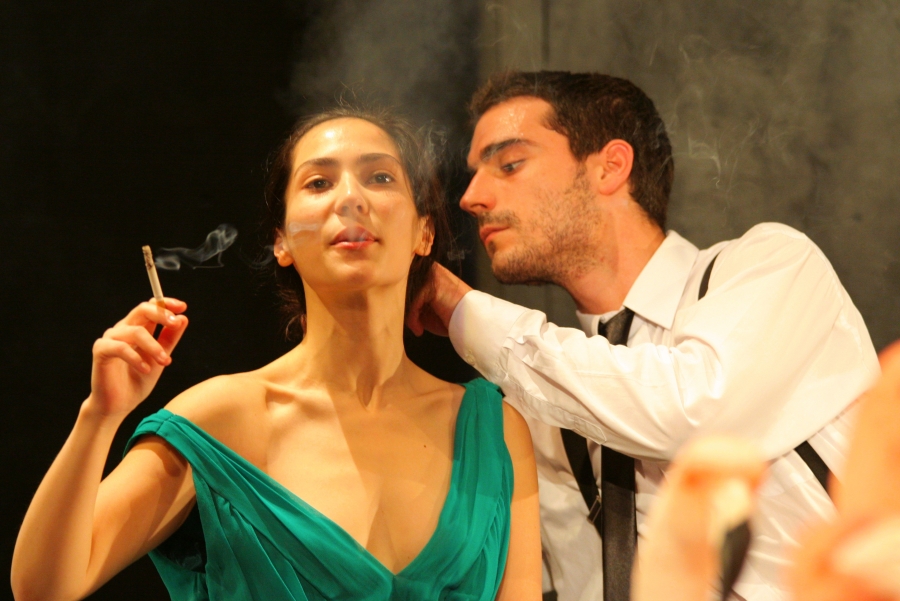
26th June 2026 Lake Bánk, the opening day of the Louis Armstrong International Jazz Festival, this is the premiere of the jazz opera, which is made of the South-African Can Themba’s work, of The Suit. From the prose, which was born in the 50s of the last-century with the usage of the dramatization of the Ethiopian Mothoba Mutloatse and Barney Simon, Zoltán Balázs made a libretto, and the music was composed by Adrián Kovács. (From Themba’s short story, for the first time in Europe, Peter Brook directed a performance in 2004.) The three characters (Csilla Radnay, Barna Kelemen Bányai and Ferenc Fehér) of the play, which deals with the domestic violence, are crammed in a small crowded place, it can also strengthen the depressing psychological experience of the relationships between the singer wife, the jealous husband, who rules her and the secret lover.
These performances can mark the borders of the Maladype Theatre in time, and these also mean the beginning and ending points of my self-history, which is connected to the theatre. Without taking into consideration these latest times, I have seen almost all of their performances because from their first performance it was obvious: Zoltán Balázs is one of those few directors with restless soul, whose natural habitat is the continuous searching and renewing, in the praxis of whom we cannot find that satisfied comfort because of the fulfilled results. With a little bit of simplification, I can state, that the Maladype is Zoltán Balázs himself. (We made an interview with the director in 2011.) If we think about the fact, that most of the performances have been directed by him, and during it how many times has the troupe changed around him, and that during the latest times, when in Hungary the possible work with the troupe has become impossible, then the director’s performances were born mostly abroad, in different cooperation, this also proves my idea mostly.
Twenty-five years is a long time, and this history of the quarter of a century can show a continuation and it is divided into more periods at the same time. The changings can be connected mostly to the new places of performance of the troupe. From Tavaszmező Street they went to the Bárka Theatre, from there to the Old Studio of Thália Theatre, until that time, they could finally form their own base in one of the flat of the Mikszáth Square. When they had to move out there, they could find a place in the Eötvös 10.
They have also been affected by the political and governmental sabotage which stroke the independent troupes, as a result of it, the permanent troupe broke up and the moving on is supported by international cooperation even today. In connection with it, they form performances on four continents of the world, in which there are more or less Hungarian performers or contributors too. From 2025 Zoltán Balázs is the art leader of the METTRIN Arts Centre that can be found by the Lake Bánk, and this institution can become the performing place and cooperative partner of the performances of Maladype, their educational and other actions (The Suit was also born with the cooperation of the METTRIN, the Jazz Festival and foreign partners.)
In the different places they could form different places, and it on its own, defines the staging and acting approach of each plays. The Fencing Hall in the Bárka, with its big size offered different possibilities, than the tiny studio of the Thália or their Base, which “theatre hall” was formed in the dining room of a civilian flat. And while in their cases they had the possibility to leave the traditional opposing auditorium-stage relation, they could not do it in Eötvös 10. They could perform anywhere this theatre can be seen as the poor theatre from Grotowski’s point of view. The performances have happened many times in empty places or almost empty places, or maybe some emblematic objects, furniture (for example the pile of newspapers, one billiard table) can serve as a point of reference of the place to show the stories.
In the latest performance, Balázs narrows to the place to the minimal, when he uses the mapping of “stage on the stage”. It is true in case of The Penelopiad, which was performed in 2024, as well as of The Puppetmaster, which was performed a year later in cooperation with the Csokonai National Theatre of Debrecen. The earlier one was made on the base of Margaret Atwood’s tiny novel, and it tells Ulysses’ story from the wife’s point of view, the sufferings of the twenty years long waiting. The three performers, who are dressed in exotic clothes (Gabriella Varga, Nelli Orbán, Edina Bajkó) can show in solo and choir, in prose and in songs, with music and with choreographed movements while they are sitting on the same place, the mixture of the antique and the modern. The other one is Giles Segal’s play, the main character of which, who has lived through the camp in Birkenau and now closes himself into a motel in Berlin, cannot believe that the world war finished five years ago. He is preparing for the big performance of his life together with the puppets of his dead wife and never born child. Máté Gergely Kiss (Finkenstein), Olga Újhelyi (Owner Woman), János Mercs (visitor) and Ruth Nache Lopez/Elise Paris Turco (the puppet of the wife) are balancing between the tragedy and the variety show while they are talking about the leaving of the memories of holocaust.
If think about the almost half hundred performances of the troupe, my strongest impression is the performers’ risk taking, which can be seen in case of the choice of the play, and of the staging of them. On one hand, they have put on stage many plays, which are hardly, or which have never performed in Hungary, on the other hand, they interpret the well-known classical ones from very new viewpoint. Into the first group we can put the writes like Brecht (Don Juan), Cocteau (Tristan and Isolde), Dorst (Merlin), Genet (The Blacks), Ghelderode (School for Fools), Goethe (Egmont), Hölderlin (Empedocles) Lang (Metropolis), Meaterlinck (Pelléas and Mélisande), Musset (Lorenzaccio), Sartre (Flies), Schulz (August), Wyspiański (Acropolis).
Into the second one, between the others, we can put Bulgakov (Master and Margarita), Büchner (Woyzeck, Leonce and Lena), Chekov (Platonov, Three Sisters), Jarry (Ubu King), Osztrovszkij (The Tempest), Schiller (Don Carlos), Shakespeare (Macbeth, III. Richard), Vörösmarty (Csongor and Tünde). Their programmes has a third layer too, in which they get away from the written play, and in these performances (Egg(s)Hell, Dada Cabaret, Outlet, Great Sound in the Rush) the actors’ stylistic multiple nature can prevail with their whole wealth and the multidisciplinary art nature of the performances. The perfect opposition of this theatrical trend is that “anti-theatre”, the whole evening long reading, which Zoltán Balázs edited and performed from Viktor Kravchenko’s – published by the theatre – book, the title of which is the I Chose Freedom, which shows the Soviet reality.
The troupe of Maladype has always been characterised by the continuity and the variety, the consistency and the openness. In all stages of its function there has been a formed smaller troupe, which can mean a temporal stability, to which for some performances some invited actors have been connected. Giant encounters have been born. Between the most memorable ones for me, let me make us remember Ilona Béres’ formation of the characters in Theomachia by Sándor Weöres, or Andrea Ladányi in the Inferno by Dante, Mari Töröcsik in The Marriage of Figaro, Gyöngyi Blasek in Don Carlos. And then I have not mentioned yet Sándor Zsótér’s presence, whose performances (Acropolis, Lorenzaccio, The Marriage of Figaro, Don Juan, The Balcony, III. Richard) have been important part of the formation of the style of Maladype.
The importance of this style cannot be found in the consistency of the method of performing, in contrary to it, in the continuous renewing. The base of the artistic performance of the troupe have always been the intensive workshop-like work, the close unity of text, music, movement and vision, the inspiration by different cultures, the searching for adequate artistic tools, the reflection for the viewers’ reactions. However, the formal performing of each performances are different of course, in the depth the same thing forms a relationship between them: the united theatrical thinking, that complex performing intention, which wants to have effect on mentality, feelings and senses too. The community of Maladype can embody some kind of open theatrical model, according to which they do not only create performances, but have workshops, programmes to form a community, to educate in a theatrical way and introduce too, besides they hold cultural and educational series too.
The Maladype Theatre celebrates its quarter of a century long anniversary not only with the premiere of The Suit, but with the publishing of a book about their history and with the foundation of a reputable award too. When the troupe was ten years old, they summarised in the imposing album-like book of Maladype 10 years their career until then, and now they are preparing to go on with it. THE MALADYPE +15 YEARS , according to the previous information – “will not only inform us about the performances, events and performers, but it will also give a cross-sectional view of their special operation over the periods, those strategies that can support their maintenance and of their widespread actions of culture diplomacy”.
Since 2000 Judit Gombár, set- and costume designer, university professor, who won Mari Jászai award, and became a meritorious artist, who had previously been one of the founders and permanent designer of the Ballet in Győr, was Zoltán Balázs’ permanent colleague. The Maladype Theatre in her honour and memory has founded the Judit Gombár Multidisciplinary Art Award. With it, “they would like to appreciate those artists’ work, who has outstanding qualities, whose point of view and innovative aims can settle a new measure in front of the future of theatre and its related arts.” About the giving of the award an advisory board decides, whose members have been requested by the Foundation, The award ceremony will be held annually on 13th September, on Judit Gombár’s birthday between celebratory circumstances – but because of financial reasons, the first ceremonial act of this year will be held on a later date.
God gives – and the circumstances and the fate – that Maladype Theatre can go on newer performing discoveries and will be presented on the constant high level of quality in the Hungarian and international theatrical life.
István Nánay, Revizor Online, 2026
(translated by: Veronika Fülöp)
The Maladype Theatre, the Hungarian troupe that performs one of the most consistent workshop, they are searching for their way and able to renew, celebrates the twenty-five years old anniversary of its existence with a premiere, a book that deals with their career and with the foundation of an award.
On 13th November 2001 Tavaszmező Street, Budapest. By one of the longer sides of the big, rectangular room of the Roma Parliament there is a line of windows with view to the street, in front of it, by the wall there is an auditorium with two lines. In the almost empty place Gypsy and not Gypsy actors are performing Ionesco. I remember the actors even today (for example the duet of Erika Molnár and Oszkár Nyári) as well as the pot playing by Zoltán Oláh. And the fact too, that the jury of the Soros’ Studio Theatre Days accepted with such an enthusiasm the performance of Jack, or the Submission.
26th June 2026 Lake Bánk, the opening day of the Louis Armstrong International Jazz Festival, this is the premiere of the jazz opera, which is made of the South-African Can Themba’s work, of The Suit. From the prose, which was born in the 50s of the last-century with the usage of the dramatization of the Ethiopian Mothoba Mutloatse and Barney Simon, Zoltán Balázs made a libretto, and the music was composed by Adrián Kovács. (From Themba’s short story, for the first time in Europe, Peter Brook directed a performance in 2004.) The three characters (Csilla Radnay, Barna Kelemen Bányai and Ferenc Fehér) of the play, which deals with the domestic violence, are crammed in a small crowded place, it can also strengthen the depressing psychological experience of the relationships between the singer wife, the jealous husband, who rules her and the secret lover.
These performances can mark the borders of the Maladype Theatre in time, and these also mean the beginning and ending points of my self-history, which is connected to the theatre. Without taking into consideration these latest times, I have seen almost all of their performances because from their first performance it was obvious: Zoltán Balázs is one of those few directors with restless soul, whose natural habitat is the continuous searching and renewing, in the praxis of whom we cannot find that satisfied comfort because of the fulfilled results. With a little bit of simplification, I can state, that the Maladype is Zoltán Balázs himself. (We made an interview with the director in 2011.) If we think about the fact, that most of the performances have been directed by him, and during it how many times has the troupe changed around him, and that during the latest times, when in Hungary the possible work with the troupe has become impossible, then the director’s performances were born mostly abroad, in different cooperation, this also proves my idea mostly.
Twenty-five years is a long time, and this history of the quarter of a century can show a continuation and it is divided into more periods at the same time. The changings can be connected mostly to the new places of performance of the troupe. From Tavaszmező Street they went to the Bárka Theatre, from there to the Old Studio of Thália Theatre, until that time, they could finally form their own base in one of the flat of the Mikszáth Square. When they had to move out there, they could find a place in the Eötvös 10.
They have also been affected by the political and governmental sabotage which stroke the independent troupes, as a result of it, the permanent troupe broke up and the moving on is supported by international cooperation even today. In connection with it, they form performances on four continents of the world, in which there are more or less Hungarian performers or contributors too. From 2025 Zoltán Balázs is the art leader of the METTRIN Arts Centre that can be found by the Lake Bánk, and this institution can become the performing place and cooperative partner of the performances of Maladype, their educational and other actions (The Suit was also born with the cooperation of the METTRIN, the Jazz Festival and foreign partners.)
In the different places they could form different places, and it on its own, defines the staging and acting approach of each plays. The Fencing Hall in the Bárka, with its big size offered different possibilities, than the tiny studio of the Thália or their Base, which “theatre hall” was formed in the dining room of a civilian flat. And while in their cases they had the possibility to leave the traditional opposing auditorium-stage relation, they could not do it in Eötvös 10. They could perform anywhere this theatre can be seen as the poor theatre from Grotowski’s point of view. The performances have happened many times in empty places or almost empty places, or maybe some emblematic objects, furniture (for example the pile of newspapers, one billiard table) can serve as a point of reference of the place to show the stories.
In the latest performance, Balázs narrows to the place to the minimal, when he uses the mapping of “stage on the stage”. It is true in case of The Penelopiad, which was performed in 2024, as well as of The Puppetmaster, which was performed a year later in cooperation with the Csokonai National Theatre of Debrecen. The earlier one was made on the base of Margaret Atwood’s tiny novel, and it tells Ulysses’ story from the wife’s point of view, the sufferings of the twenty years long waiting. The three performers, who are dressed in exotic clothes (Gabriella Varga, Nelli Orbán, Edina Bajkó) can show in solo and choir, in prose and in songs, with music and with choreographed movements while they are sitting on the same place, the mixture of the antique and the modern. The other one is Giles Segal’s play, the main character of which, who has lived through the camp in Birkenau and now closes himself into a motel in Berlin, cannot believe that the world war finished five years ago. He is preparing for the big performance of his life together with the puppets of his dead wife and never born child. Máté Gergely Kiss (Finkenstein), Olga Újhelyi (Owner Woman), János Mercs (visitor) and Ruth Nache Lopez/Elise Paris Turco (the puppet of the wife) are balancing between the tragedy and the variety show while they are talking about the leaving of the memories of holocaust.
If think about the almost half hundred performances of the troupe, my strongest impression is the performers’ risk taking, which can be seen in case of the choice of the play, and of the staging of them. On one hand, they have put on stage many plays, which are hardly, or which have never performed in Hungary, on the other hand, they interpret the well-known classical ones from very new viewpoint. Into the first group we can put the writes like Brecht (Don Juan), Cocteau (Tristan and Isolde), Dorst (Merlin), Genet (The Blacks), Ghelderode (School for Fools), Goethe (Egmont), Hölderlin (Empedocles) Lang (Metropolis), Meaterlinck (Pelléas and Mélisande), Musset (Lorenzaccio), Sartre (Flies), Schulz (August), Wyspiański (Acropolis).
Into the second one, between the others, we can put Bulgakov (Master and Margarita), Büchner (Woyzeck, Leonce and Lena), Chekov (Platonov, Three Sisters), Jarry (Ubu King), Osztrovszkij (The Tempest), Schiller (Don Carlos), Shakespeare (Macbeth, III. Richard), Vörösmarty (Csongor and Tünde). Their programmes has a third layer too, in which they get away from the written play, and in these performances (Egg(s)Hell, Dada Cabaret, Outlet, Great Sound in the Rush) the actors’ stylistic multiple nature can prevail with their whole wealth and the multidisciplinary art nature of the performances. The perfect opposition of this theatrical trend is that “anti-theatre”, the whole evening long reading, which Zoltán Balázs edited and performed from Viktor Kravchenko’s – published by the theatre – book, the title of which is the I Chose Freedom, which shows the Soviet reality.
The troupe of Maladype has always been characterised by the continuity and the variety, the consistency and the openness. In all stages of its function there has been a formed smaller troupe, which can mean a temporal stability, to which for some performances some invited actors have been connected. Giant encounters have been born. Between the most memorable ones for me, let me make us remember Ilona Béres’ formation of the characters in Theomachia by Sándor Weöres, or Andrea Ladányi in the Inferno by Dante, Mari Töröcsik in The Marriage of Figaro, Gyöngyi Blasek in Don Carlos. And then I have not mentioned yet Sándor Zsótér’s presence, whose performances (Acropolis, Lorenzaccio, The Marriage of Figaro, Don Juan, The Balcony, III. Richard) have been important part of the formation of the style of Maladype.
The importance of this style cannot be found in the consistency of the method of performing, in contrary to it, in the continuous renewing. The base of the artistic performance of the troupe have always been the intensive workshop-like work, the close unity of text, music, movement and vision, the inspiration by different cultures, the searching for adequate artistic tools, the reflection for the viewers’ reactions. However, the formal performing of each performances are different of course, in the depth the same thing forms a relationship between them: the united theatrical thinking, that complex performing intention, which wants to have effect on mentality, feelings and senses too. The community of Maladype can embody some kind of open theatrical model, according to which they do not only create performances, but have workshops, programmes to form a community, to educate in a theatrical way and introduce too, besides they hold cultural and educational series too.
The Maladype Theatre celebrates its quarter of a century long anniversary not only with the premiere of The Suit, but with the publishing of a book about their history and with the foundation of a reputable award too. When the troupe was ten years old, they summarised in the imposing album-like book of Maladype 10 years their career until then, and now they are preparing to go on with it. THE MALADYPE +15 YEARS , according to the previous information – “will not only inform us about the performances, events and performers, but it will also give a cross-sectional view of their special operation over the periods, those strategies that can support their maintenance and of their widespread actions of culture diplomacy”.
Since 2000 Judit Gombár, set- and costume designer, university professor, who won Mari Jászai award, and became a meritorious artist, who had previously been one of the founders and permanent designer of the Ballet in Győr, was Zoltán Balázs’ permanent colleague. The Maladype Theatre in her honour and memory has founded the Judit Gombár Multidisciplinary Art Award. With it, “they would like to appreciate those artists’ work, who has outstanding qualities, whose point of view and innovative aims can settle a new measure in front of the future of theatre and its related arts.” About the giving of the award an advisory board decides, whose members have been requested by the Foundation, The award ceremony will be held annually on 13th September, on Judit Gombár’s birthday between celebratory circumstances – but because of financial reasons, the first ceremonial act of this year will be held on a later date.
God gives – and the circumstances and the fate – that Maladype Theatre can go on newer performing discoveries and will be presented on the constant high level of quality in the Hungarian and international theatrical life.
István Nánay, Revizor Online, 2026
(translated by: Veronika Fülöp)